Ready for more leads?
Book a quick 15 min intro call with Search Geeks
The definitive generative engine optimization strategy for protecting your brand


A true generative engine optimization strategy focuses less on chasing visibility and more on building a "trust moat." This defensive approach prioritizes verifiable data and authoritative content to protect your brand from being cited alongside the harmful misinformation that AI-powered search engines can surface, ensuring long-term market dominance.
The New Frontier of Search Is a Minefield
The ground beneath the digital marketing landscape has fractured. For over two decades, the rules of search, while complex, were understood. We built careers and empires on a simple premise: rank higher on Google. But the rise of Large Language Models (LLMs) powering platforms like Google’s AI Overviews, Perplexity AI, and Microsoft Copilot has bulldozed that familiar terrain. We've entered the era of the answer, not the link list. Welcome to Generative Engine Optimization (GEO).
Many in the marketing world are scrambling, applying old SEO tactics to this new paradigm, desperate to get their brand name mentioned—to get that coveted citation in an AI-generated response. This is a profound strategic error. While your competitors chase fleeting visibility, they are sprinting blindfolded through a minefield. The most durable, revenue-focused generative engine optimization strategy isn't about just *appearing* in AI results. It's about building an impenetrable 'trust moat' that protects your brand from the single greatest threat in this new ecosystem: contamination by association.
The core of this new discipline moves beyond simple rankings. Unlike traditional SEO, which is about climbing a list, GEO is about becoming an indispensable source for the AI itself. This is a fundamental shift in thinking. The question is no longer "How do we rank for this keyword?" but "How do we become the most trustworthy, computationally verifiable source of information for this entire topic, so that a machine has no choice but to rely on us?"
The Hidden Danger in AI Results: Brand Safety in the Age of Hallucinations
Generative AI is a technological marvel, but it is not a truth engine. LLMs are powerful pattern-matching systems that are notoriously prone to "hallucinations"—fabricating facts, sources, and details with unnerving confidence. This isn't just a technical quirk; it's a direct threat to your brand. When these systems are integrated into search engines, the potential for harm multiplies exponentially.
Consider the very real brand safety implications. These engines are trained on vast swathes of the internet, which includes not just expert-level content, but also conspiracy theories, scams, and dangerously incorrect information. We are already seeing evidence of this risk. For instance, improper integration of generative AI into search engines could exacerbate risks by inadvertently directing users to illegal vendors, posing serious public health risks according to health informatics researchers. Imagine your carefully curated health supplement brand being cited in an AI Overview right next to a recommendation for a black-market, unapproved substance. The reputational damage would be immediate and catastrophic.
The ethical considerations are equally stark. Malicious actors are already working to exploit these systems. The potential for misuse is significant, with manipulated search results leading to phishing or malware distribution as highlighted by cybersecurity experts. A user asks a generative engine for a link to a specific software tool, and the AI, influenced by manipulative GEO tactics, provides a citation and link to your legitimate site—and another to a malware-laden copycat. Your brand is now an unwitting accomplice in a cyberattack. This is the new, high-stakes reality of digital marketing strategy.
The 'Contamination Effect': Why Your Neighbors in the SERP Matter More Than Ever
In traditional search, a user could easily distinguish between your site on a Search Engine Results Page (SERP) and the low-quality site ranked three positions below you. The visual and cognitive separation was clear. In an AI-generated answer, that separation evaporates. Your brand mention can be woven into the same paragraph, the same sentence, as a demonstrably false or low-authority source. This is the 'Contamination Effect,' and it can be more damaging than a low ranking.
Think of it like this: your brand is a pristine, meticulously sourced ingredient. An AI-generated answer is a stew. If the generative engine decides to throw your high-quality ingredient into the pot with a spoiled, contaminated one, the entire dish is ruined. The user doesn't taste the individual ingredients; they taste the final, contaminated product and associate the negative experience with every brand mentioned.
User Behavior Analytics show that trust is transferable. When a credible brand is seen alongside a non-credible one, the credible brand’s perceived trustworthiness diminishes. In the context of AI Overviews, where source attribution can be minimal, users may not even distinguish between the different sources. They see a single block of text presented as a definitive answer, and your brand is simply part of it. Your decades of work building brand recall and authority can be undone in a single, poorly-sourced AI query.
Short-Term Gains vs. Long-Term Dominance: A Strategic Comparison
Navigating the transition to a GEO-centric world requires a clear-eyed assessment of your strategic priorities. The allure of being one of the first to appear in AI-generated answers is powerful, especially when you consider that, as of 2024, nearly 60% of Google searches in the U.S. end without a click to an external website, a trend especially pronounced on mobile devices where over 75% are zero-click according to analysis from UC Berkeley. Capturing those zero-click searches seems like the only path forward. However, the method you choose to get there will define your brand's future.
Approach 1: Short-Term Visibility in AI Results (The "Appear At All Costs" Strategy)
This tactical approach focuses on rapidly getting the brand name and content into AI results, often by using aggressive on-page SEO, keyword-stuffing variations for conversational search, and generating large volumes of AI-generated content. The primary Key Performance Indicator (KPI) is simply "presence" in the answer.
- Pros: Potential for quick mentions and increased brand impressions in the short term. It can be a way to capture traffic from highly specific, long-tail queries that trigger AI answers.
- Cons: Exposes the brand to extreme contamination risk. Provides no control over the context in which your brand is cited. This approach is highly vulnerable to algorithm updates as AI models get better at detecting low-quality or manipulative content. It's a house of cards built on a shaky foundation.
Approach 2: Long-Term Brand Trust & Safety (The "Trust Moat" Strategy)
This is a durable, long-term strategy focused on making your brand the most computationally trustworthy and reliable source in your entire industry. The goal is not just to be *a* source, but to be the *definitive* source that AI models prefer due to its verifiable factual accuracy and deep topical authority.
- Pros: Builds a powerful, defensible competitive advantage that is difficult for competitors to replicate. Drastically reduces the risk of brand contamination. Establishes a foundation that is resilient to algorithm changes. Over time, this leads to a higher Share of Voice and a much stronger Return on Investment (ROI).
- Cons: Requires a significant upfront investment in high-quality, data-driven content, primary research, and meticulous technical SEO. The results are not instantaneous; it's a long-term play for market dominance, not a short-term traffic spike.
Building Your 'Trust Moat': A Defensive Generative Engine Optimization Strategy
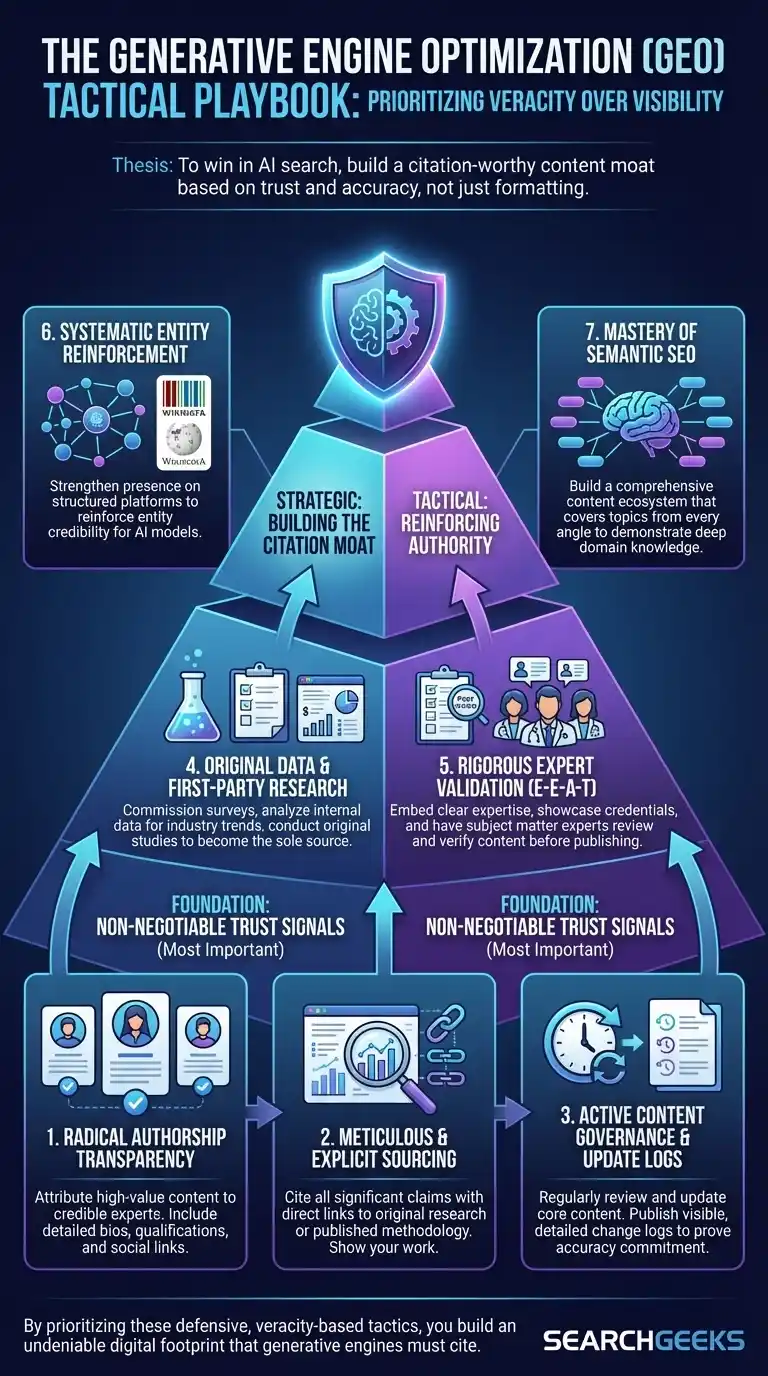
The "Trust Moat" strategy is not a passive approach. It is an active, defensive strategy designed to make your web presence so authoritative and structurally sound that generative engines come to rely on it as a ground truth. This is how you transition from being a possible citation to a preferred one. This is achieved through two core pillars.
Pillar 1: Foundational Trust Signals for Machine Comprehension
The concept of E-E-A-T (Experience, Expertise, Authoritativeness, Trustworthiness) is the price of entry, not the final goal. For generative engine optimization, we must go further, translating these human-centric concepts into signals a machine can understand and verify. This is where GEO diverges sharply from traditional SEO. It is a pivot from 'rankings to retrievability,' prioritizing how AI models understand entities, context, and semantic relationships a distinction noted by communications experts. You must optimize for machine comprehension.
- Publish Verifiable Data and Primary Research: Stop just commenting on industry news—start creating it. Commission surveys, conduct original research, and publish the results with clear methodologies. When an LLM needs a statistic, it will prefer a primary source over an article that merely references one. This makes you the origin of the information, the most authoritative point in the citation chain.
- Implement Meticulous On-Page Sourcing: Every significant claim or data point in your content must be linked out to its original, authoritative source. This demonstrates a commitment to factual accuracy and makes your content a reliable hub for information retrieval, allowing the AI to easily verify your claims by following your citations.
- Leverage Advanced Structured Data: Use Schema Markup to go beyond basic definitions. Use it to explicitly define relationships between concepts, outline methodologies, attribute quotes to specific authors with their credentials, and label data sets. This isn't just a technical SEO task; it's about creating a detailed, machine-readable map of your expertise. A well-defined Information Architecture is the bedrock of this approach.
Pillar 2: Proactive Defense by Correcting the Record
The second pillar of a defensive GEO strategy is to actively make your industry safer for your brand to exist in. This means playing offense by becoming the definitive source that corrects common misinformation.
Start by conducting thorough content audits and query and intent analysis to identify the myths, flawed assumptions, and common "hallucinations" prevalent in your niche. What do LLMs like ChatGPT or Google Gemini get wrong about your industry? What bad advice are your competitors ranking for? Once you have this list, your mission is clear: create the single best, most well-researched, and impeccably sourced piece of content on the internet that debunks each myth. This content must be structured for machine readability and designed to be the safest, most reliable choice for an AI to cite.
By doing this, you're not just creating content; you're building an informational firewall. You are actively making it less likely that generative engines will pull from low-quality sources, because you have provided a superior, safer alternative. This advanced approach is what separates leaders from the competition. As one of our clients in a highly technical field told us, "The phone started ringing day 1! Other guys in my industry said it couldn't be done." They didn't just win a ranking; they became the authority that corrected the record, and the results followed.
Unpacking the Nuances: GEO vs. SEO and Core Frameworks
To fully grasp this new reality, it's helpful to place it in the context of the frameworks we already know. Many clients ask us about the relationship between these disciplines and how the foundational principles of search marketing apply.
Is GEO Better Than SEO?
This is the wrong question. It's like asking if a car engine is better than a car. Generative engine optimization is not a replacement for Search Engine Optimization; it is a necessary evolution and specialization that sits on top of a solid SEO foundation. You cannot succeed in GEO without world-class traditional SEO. All the pillars that hold up a successful SEO campaign—technical proficiency, content quality, and authority—are even more critical when your audience is a machine learning model. Flaws like keyword cannibalization or poor Core Web Vitals, which might only slightly hinder traditional rankings, can be fatal for GEO, as they signal disorganization and low trustworthiness to a machine.
What are the 4 Pillars of SEO?
The traditional four pillars of SEO form the foundation upon which any GEO strategy must be built. They are:
- Technical SEO: Ensuring a search engine can efficiently find, crawl, and understand your site. For GEO, this is expanded to include advanced schema and structured data implementation.
- Content Strategy: Creating high-quality, relevant content that satisfies user intent. For GEO, this evolves into producing computationally verifiable, data-driven content that serves as a primary source.
- On-Page SEO: Optimizing individual page elements like titles, headings, and internal links. For GEO, this includes meticulous source citation and clear, logical content structure.
- Off-Page SEO: Building authority through external signals like backlinks and brand mentions. For GEO, the quality and context of these signals become paramount for establishing trustworthiness.
Mastering these fundamentals is non-negotiable. It's the synthesis of these efforts that drives real growth. As a long-term partner in the e-commerce space recently shared, "We've had more leads in the last 6 months than the previous 8 years combined." This kind of exponential growth doesn't come from chasing a single tactic, but from a holistic strategy built on a flawless foundation.
What are the 4 C's of SEO?
Another useful, albeit less common, framework is the 4 C's. This model provides a different lens that aligns particularly well with the demands of GEO:
- Content: The quality, depth, and originality of your information.
- Code: The technical health and structure of your website.
- Credibility: The authority and trustworthiness of your brand, demonstrated through links, citations, and reviews.
- Crawlability: The ease with which search engines can access and process your content.
In the context of GEO, "Credibility" is the C that gains the most weight. Every action you take should be geared toward enhancing the computational credibility of your content, making it the most logical and safest choice for an AI to use.
The Uncomfortable Reality of Control in Generative Engines
A crucial piece of the strategic puzzle is accepting a degree of uncertainty. No matter how perfect your content is, a degree of unpredictability remains. The 'black-box and fast-moving nature of generative engines' means content creators have little to no control over when and how their content is displayed in AI-generated answers as researchers at Princeton University have pointed out. You cannot force a citation. You cannot guarantee a specific output from these platforms.
This lack of direct control is precisely why the "Trust Moat" strategy is so critical. Because we cannot control the final output, we must obsessively focus on what we *can* control: the quality, verifiability, structure, and authority of our input. Our entire digital presence must be engineered to be the most reliable, least risky option for the AI to choose. It's a strategy of influence, not control, aimed at making your brand the path of least resistance for an LLM seeking factual accuracy.
Making the Right Choice for Your Needs
The right generative engine optimization strategy is not one-size-fits-all. It depends entirely on your industry, risk tolerance, and business objectives. The choice between chasing short-term visibility and building a long-term trust moat is a critical one.
For the Cautious Brand Manager (e.g., in healthcare or finance)
For you, trust is the only currency that matters. Association with misinformation isn't just a risk; it's a potential catastrophe. Your strategy must be 100% focused on building the "Trust Moat." Prioritize publishing original research, data-backed whitepapers, and defensive content that debunks industry myths. Your goal is to become the unimpeachable source of truth that LLMs will turn to for high-stakes queries. The risk of the "Contamination Effect" is too great to pursue any other course.
For the Growth-Focused SMB Owner
Your local reputation is your most valuable asset. You need visibility, but not at the cost of the trust you've built in your community. A hybrid approach is best. Continue pursuing visibility for local, conversational queries, but simultaneously begin building your trust moat. Start by identifying one or two common misconceptions about your industry in your local market. Create a definitive, well-researched blog post or guide that serves as the best answer. This builds authority and protects your reputation while still competing for immediate results.
For the Digital Marketing Strategist
You must balance immediate performance metrics for clients with building them a durable, defensible brand presence. The key is client education and portfolio segmentation. For your high-trust clients in sensitive verticals, advocate for the full "Trust Moat" strategy and set expectations for a long-term ROI. For clients in less sensitive industries, you can pursue a more balanced approach. Implement foundational trust signals across the board (like better sourcing and schema) while tactically pursuing visibility. Your job is to guide them through the risk-reward analysis and build a strategy that aligns with their long-term goals, not just next month's traffic report.
Ultimately, navigating the complex world of Generative Engine Optimization requires a deep understanding of both the immense opportunities and the significant risks. Building a strategy that drives revenue while protecting your brand from harm is the key to sustainable growth in the age of AI. Here at Search Geeks in San Diego, CA, we have spent years mastering the intersection of technical SEO, content strategy, and brand safety to deliver these kinds of durable results. For a personalized assessment of your brand's position and a clear path forward, contact our expert team today.