Ready for more leads?
Book a quick 15 min intro call with Search Geeks
What is Google SGE and why what it hides is your biggest opportunity

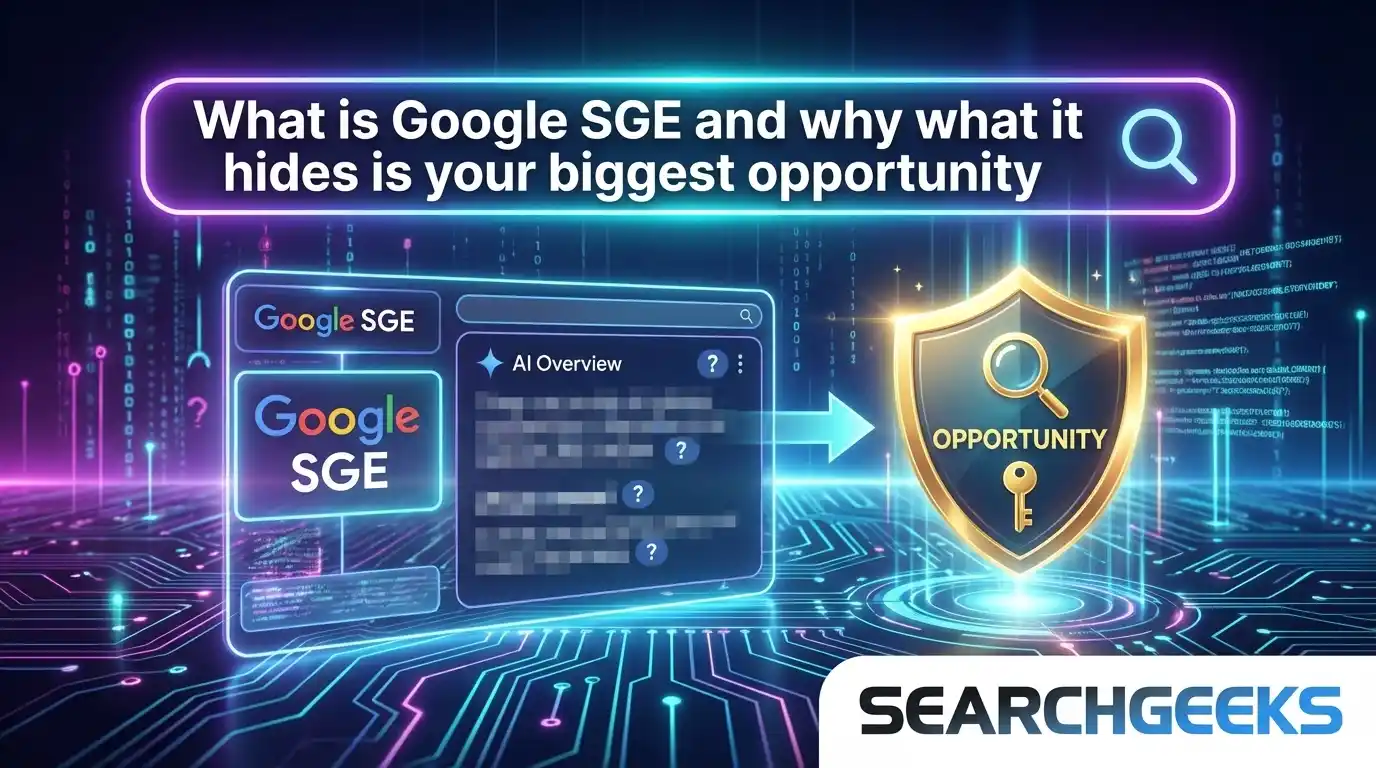
Google's Search Generative Experience (SGE) is an AI-powered feature that provides direct, conversational answers to search queries within the results page. The most critical insight for marketers, however, is not what SGE shows, but its deliberate silence on sensitive topics, revealing a new imperative for businesses to become citable, authoritative sources for AI.
The Ground Has Shifted: Understanding the New Digital Landscape
For over two decades, the game was simple: rank number one. The entire discipline of Search Engine Optimization was built on a foundation of ten blue links. We studied the search algorithm, reverse-engineered its signals, and built strategies to claim that coveted top spot. It was a war of inches, fought with keywords, backlinks, and technical precision. But the ground is no longer solid beneath our feet. A fundamental paradigm shift, announced at Google I/O and slowly rolling out, is rewriting the rules of digital marketing visibility. This shift is called the Search Generative Experience, or SGE.
At first glance, SGE appears to be an evolution. An AI snapshot, a conversational answer generated at the top of the Search Engine Results Page (SERP). It seems like a souped-up version of the Featured Snippets or People Also Ask (PAA) boxes we’ve grown accustomed to. Many marketers see this and react with a familiar panic: the fear of zero-click searches, the decimation of organic traffic, and the end of SEO as we know it. Some experts predict the rise of SGE could cause web traffic to drop between 15% and 25%, creating a 'zero-click world' according to researchers. While these concerns are valid, they are based on a surface-level reading of the situation. They miss the real story.
The most profound insight into Google SGE isn’t what it shows you. It’s what it deliberately, and strategically, hides. This calculated omission reveals Google’s core vulnerability in the age of generative AI and, in doing so, hands a new, powerful playbook to businesses and marketers who are savvy enough to see it. The new benchmark for high-value content is no longer about being merely rankable; it's about becoming a trustworthy, authoritative source that a multi-billion dollar AI can confidently cite on topics where it cannot afford to be wrong.
The Anatomy of a Revolution: What is Google SGE, Exactly?
Before we can exploit the strategic loopholes in SGE, we must first understand the machine itself. What is this new force reshaping the SERP? How does it fundamentally differ from the search we’ve known for the past 25 years? Let's break down the mechanics and user experience of this generative technology.
How SGE Works: From Keywords to Conversation
Traditional search is a marvel of information retrieval. You type in a query, and Google’s algorithm scours its massive index of the web to find the most relevant pages, ranking them based on hundreds of factors. It’s a matching game, albeit an incredibly sophisticated one.
SGE operates on a different principle: information synthesis. Instead of just matching your query to existing pages, it uses a Large Language Model (LLM)—the same underlying technology as Google Gemini (formerly Google Bard) and OpenAI's ChatGPT—to understand the *intent* and *context* of your user queries. It then reads and synthesizes information from a handful of top-ranking, authoritative web pages to construct a brand new, coherent answer, which it presents as an AI Snapshot. This is the core of conversational search.
This process relies heavily on advanced Artificial Intelligence, including Natural Language Processing (NLP), to not only understand human language but also to generate it. The AI deconstructs top content, identifies key entities and relationships through semantic search, and then re-assembles the information into a summary. Crucially, it then provides links to its sources in a carousel, a feature that is the linchpin of the new optimization strategy we will discuss. Google's stated goal for SGE includes helping users make 'complex purchase decisions faster and much easier,' indicating a focus on commercial intent queries.
The SGE User Experience: Answering Your Core Questions
For users, the change is immediate and obvious. The AI-generated content takes up significant real estate at the top of the page, pushing traditional organic results further down. Let's address the most common questions users and marketers have about this new interface.
How to activate SGE in Google?
Initially, SGE was an opt-in experiment available through Google Search Labs. Users had to manually enable it. However, as of late 2024 and into 2025, Google began integrating these AI Overviews directly into the main search results for a growing percentage of users and queries, moving it out of the SGE Beta phase. For many, there is no longer an "activation" step; it is simply part of the default Google experience. For specific features still in testing, the Search Labs icon (a beaker) in the Google app or Chrome is the gateway.
Is SGE available to everyone?
The rollout has been gradual and is ongoing. Availability depends on your geographic location, language settings, and the specific query you enter. Google is being methodical, gathering data and refining the experience. While it is not yet ubiquitous for every search by every person globally, its presence is expanding rapidly, and the clear trajectory is toward it becoming a standard feature of the search engine, not a niche experiment.
Can I turn off AI in my Google searches?
During the initial Search Labs experiment, users could easily toggle SGE on and off. As it becomes more integrated into the main SERP, a direct "off" switch is less common. For some results, a "Web" filter is available, which allows users to see a more traditional, link-based results page without the AI Snapshot. However, the long-term viability of opting out of AI-powered answers is uncertain. The future of search is undeniably intertwined with this technology.
The Tell-Tale Heart: Analyzing Google's YMYL 'Safety Net'
Now we arrive at the core of our thesis. The most revealing aspect of SGE is not its presence, but its conspicuous absence. Perform a search for "best stock picks for 2026" or "medical advice for chronic back pain." Then, search for "best hiking boots for rocky trails." You will notice a dramatic difference.
For the hiking boots query, SGE will likely generate a detailed AI Snapshot, synthesizing reviews, comparing features, and citing e-commerce and review sites. It's confident. But for the financial or medical queries, you will often find that the SGE snapshot is heavily caveated with disclaimers or, in many cases, entirely absent. The traditional ten blue links, pointing to established, authoritative domains, will reign supreme.
This is not a system failure. It is a deliberate, calculated design choice. This is Google's YMYL 'Safety Net'.
What is YMYL and Why It's Google's Greatest Fear
YMYL stands for "Your Money or Your Life." It's a term from Google's own Search Quality Rater Guidelines that categorizes topics with high stakes, where inaccurate information could cause significant harm to a person's health, financial stability, safety, or well-being. These categories include:
- Medical Advice: Information on diseases, drugs, mental health, nutrition.
- Financial Advice: Investment strategies, tax information, loans, insurance.
- Legal Information: Advice on divorce, child custody, litigation.
- News & Civic Information: Critical news events, government processes, voting information.
- High-Stakes Shopping: Major purchases like cars, homes, or higher education.
Generative AI, for all its power, has a well-documented problem with "AI hallucinations"—instances where the model confidently states incorrect information as fact. For a query about hiking boots, a hallucination is a low-risk annoyance. For a query about medication dosages or investment advice, a hallucination is a lawsuit waiting to happen. It's a brand-destroying catastrophe for a company like Alphabet Inc., whose entire value is predicated on trust and information accuracy.
E-E-A-T: The Human Heuristic for AI Trust
To combat this risk, Google is programming its AI to be exceptionally cautious with YMYL topics. It is essentially outsourcing trust. Instead of generating a potentially risky answer itself, it defaults to what it knows works: pointing users to websites that have demonstrated profound E-E-A-T (Experience, Expertise, Authoritativeness, Trustworthiness). For these critical queries, Google will generate SGE results from online sources it deems to be 'experts and authorities in their industry,' making topical authority critical.
This is the opportunity. Google’s AI is actively searching for human experts to lean on. It needs to find content that isn't just keyword-optimized, but is demonstrably trustworthy, deeply experienced, and backed by verifiable authority. While other marketers are panicking about traffic loss on generic queries, the real high-value ground is in becoming the citable, authoritative source for the complex, high-stakes questions that SGE is afraid to answer on its own. Your E-E-A-T is no longer just a signal for ranking; it’s a prerequisite for being a trusted source for the AI itself.
The New Mandate: From SEO to 'CSO' (Cited Source Optimization)
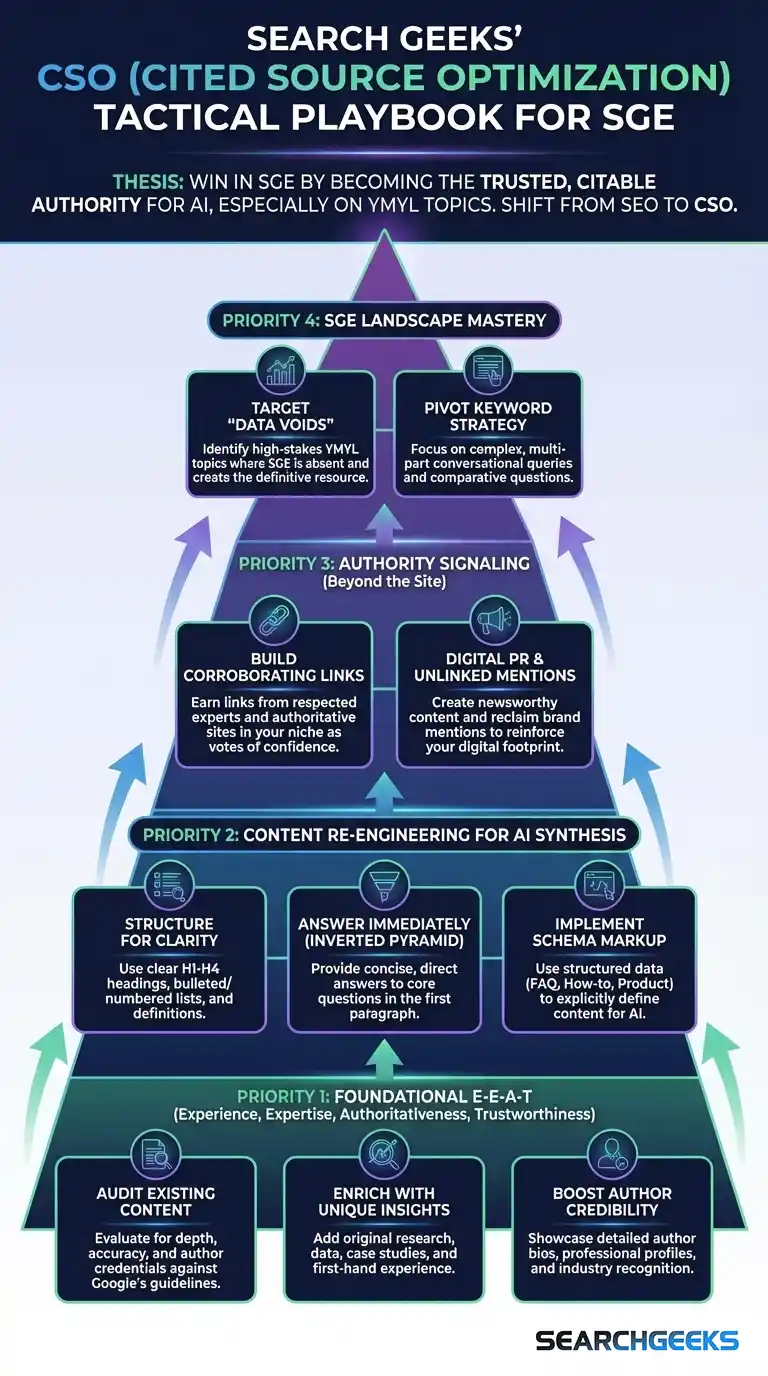
This YMYL safety net creates a new imperative for digital marketing. The primary goal is no longer just "Search Engine Optimization." It's "Cited Source Optimization" (CSO). The game has evolved from getting a click on a blue link to earning a citation within the AI Snapshot. A citation is more than a link; it's an endorsement by Google's AI, a stamp of approval that your content is a foundational piece of the answer.
This requires a fundamental shift in content strategy. It’s a move away from high-volume, surface-level articles designed to capture broad traffic and a pivot toward creating definitive, cornerstone assets that are so comprehensive and well-supported that the AI has no choice but to rely on them.
What Makes Content 'Citable' for an AI?
An LLM doesn't "read" like a human. It ingests and processes data, looking for patterns, corroboration, and signals of authority. The process is a complex stream of data analysis, where every element of your content acts as a signal. Think of how a system processes a file; it needs clear instructions, like an `obj filter flatedecode length` command, to properly interpret the data. Your content needs to provide that level of clarity to the AI. Here’s what it’s looking for:
- Verifiable Data and Statistics: Content that makes specific, quantifiable claims and, crucially, cites the primary sources for that data. This demonstrates rigor and allows the AI to cross-reference your information.
- Expert-Level Detail: Articles that go beyond the "what" and deeply explore the "how" and "why." They demonstrate first-hand experience and cover a topic with a level of nuance that generalist content farms cannot replicate.
- Structural Clarity: Content that is well-organized with a logical hierarchy of headings (H1, H2, H3), uses lists to break down complex information, and employs schema markup to explicitly define entities for the search engine. This makes your content machine-readable.
- Consensus and Corroboration: The AI looks for information that is supported by other authoritative sources. A key part of CSO is not just publishing on your own site, but also building a web of citations and links from other respected sites in your industry, reinforcing your claims. This is where link building evolves from a ranking tactic to a trust-building exercise.
- Unique Information Gain: Does your content bring a new perspective, new data, or a more comprehensive synthesis to the table? If you are simply rephrasing what the top 5 results already say, you offer no new value to the AI. Your goal is to be the source others rephrase.
To be visible in SGE, websites need to adapt their content to ensure visibility in the new 'snapshot carousel'. This requires this new, deeper approach to content quality. It’s about building brand visibility not just with users, but with the AI itself. The goal is to become one of the 3-5 sources the AI relies upon for its synthesis. While this might result in fewer overall clicks for some queries, the traffic that does come through is pre-qualified and holds much higher intent. These users have seen your brand endorsed by Google's AI as a source of truth.
Reading Between the Lines: Deconstructing the 'Experimental' Label and Data Voids
Google’s own language provides further clues to its strategy and the opportunities this creates. For years, the SGE feature has carried a prominent disclaimer. In its current form, Google SGE displays an AI-generated answer above the traditional search results, and labels the feature with the disclaimer 'Generative AI is experimental'. This is not just legal boilerplate; it's a strategic message.
The 'Experimental' Hedge: Why the Web Still Wins
This label is Google's public admission that it knows its generative AI is not infallible. It's a hedge against the inevitable mistakes, biases, and hallucinations. More importantly, it signals that the bedrock of the internet—the vast, distributed network of original, authoritative publisher websites—remains the ultimate source of truth. The AI snapshot is a derivative work, a summary layer built on top of the original content created by experts like you.
This reinforces the continued dominance and necessity of maintaining a powerful organic presence. The AI needs high-quality raw materials to create its summaries. Without expert-driven, in-depth web pages, the generative experience would collapse into a self-referential loop of mediocre, AI-generated content feeding other AI models. By focusing on CSO, you are not abandoning SEO; you are feeding the very machine that sits atop the traditional search results. Your content serves a dual purpose: ranking in the traditional results that appear below the snapshot (and for queries where a snapshot is absent) and serving as a citable source within the snapshot itself.
The 'Data Void' Advantage: Where Silence Is a Green Light
The most potent application of this thinking lies in identifying what we call 'Data Voids'. A Data Void is a query or topic where you expect to see an SGE snapshot, but none appears. This silence is a powerful signal. It means that after scanning the top-ranking content, Google's Multitask Unified Model (MUM) and underlying LLMs have concluded that there is not enough clear, consistent, or authoritative information to confidently synthesize an answer.
The AI has looked at the available content and found it lacking. This is a prime opportunity. A data void is a roadmap telling you exactly where to create the definitive piece of content. By identifying these gaps, you can build a content strategy for AI that is laser-focused on becoming the solution to Google's problem.
How do you find these voids?
- Analyze Complex Queries: Go beyond simple head-term keyword research. Focus on the long-tail, multi-step questions your customers ask. These are the queries SGE was built for, and where its absence is most telling.
- Audit YMYL Topics in Your Niche: Systematically search for the highest-stakes questions in your industry. Where does SGE appear, and where does it shy away? The gaps are your content targets.
- Look for SERP Volatility: If the top 10 results for a query are constantly changing, it often indicates Google itself is not confident about who the true authority is. This is a ripe environment for a definitive piece of content to take hold and also a likely candidate for a data void.
Creating content to fill a data void is the ultimate CSO play. You are not just trying to rank; you are providing the foundational information that allows Google to generate a trusted AI experience for that topic. When you succeed, your site becomes inextricably linked with the answer, positioning you as the preeminent authority.
The Strategic Crossroads: Weighing Your Options in the SGE Era
Understanding the new landscape is one thing; navigating it is another. Businesses are now faced with a strategic choice. Do you stick with the tried-and-true methods of traditional SEO, or do you pivot to embrace the new reality of SGE and CSO? The answer depends on your goals, resources, and risk tolerance. Let's compare the core options and the factors that should drive your decision.
Core Strategy 1: Traditional SEO (Ranking Focus)
Description: This approach continues to focus on achieving high rankings within the traditional "10 blue links" section of the SERP. The primary KPIs are keyword rankings, organic traffic volume, and impressions. The strategy relies on classic SEO tactics like on-page optimization, technical SEO, and building a high volume of backlinks.
Pros: It's a known quantity with established best practices. It still holds immense value, especially for YMYL queries where SGE is absent and for the significant portion of users who scroll past the AI snapshot. High traffic volumes can support ad-based revenue models and broad brand awareness.
Cons: It is increasingly vulnerable to traffic erosion from zero-click searches and AI snapshots. A focus purely on volume can lead to attracting lower-intent users, increasing bounce rates and decreasing conversion rates. It can become a race to the bottom on content quality just to capture keywords.
Core Strategy 2: SGE Visibility (AI Citation Focus)
Description: This approach, or CSO, prioritizes becoming one of the citable sources within the AI snapshot. The primary KPIs are source citations, brand mentions in AI answers, and referral traffic from the snapshot carousel. The strategy focuses on creating definitive, expert-driven content, building topical authority, and earning links from other highly authoritative sources.
Pros: It positions your brand as an ultimate authority, endorsed by Google's AI. The traffic generated is often from users with extremely high intent who are further down the decision-making funnel. This approach is inherently future-proof, aligning your strategy with the direction Google is heading.
Cons: It can be more resource-intensive, requiring true subject matter expertise and significant investment in cornerstone content. The direct traffic volume may be lower than with traditional SEO, making it a potentially harder sell for stakeholders focused on top-of-funnel metrics.
Metric Focus: High-Volume Traffic vs. High-Intent Leads
Description: This isn't a strategy so much as a philosophical choice that informs your strategy. Do you measure success by the number of people who visit your site, or by the number of qualified leads and sales generated? Traditional SEO often optimizes for the former, while SGE/CSO optimization inherently targets the latter.
High-Volume Pro: Excellent for brand awareness campaigns and businesses with ad-supported revenue models. A large top-of-funnel is necessary for some business models.
High-Intent Pro: Far more efficient for lead generation and sales. Attracts users who are actively seeking a solution and are closer to a purchasing decision. This focus on efficiency can lead to incredible ROI. As one of our clients in a highly competitive trade noted, after we implemented this new approach, "The phone started ringing day 1! Other guys in my industry said it couldn't be done." The focus shifted from vanity traffic to actual revenue.
Key Decision Factors for Your Business
To choose the right path, you must evaluate your strategy against the factors that will determine success in the next era of search.
Future-Proofing: How to adapt marketing strategy for the shift to AI-driven search. The trajectory of search is clear. Generative AI is not a fad; it is the future. A strategy that ignores SGE is a strategy that is building on sand. While traditional SEO remains essential, it must be adapted. The most future-proof approach is a hybrid one: continue to optimize for traditional rankings while simultaneously building the deep, authoritative content required for SGE citation. This ensures you capture traffic today while positioning yourself for dominance tomorrow. Source Authority: The need to become a citable expert for AI, not just another search result. In the past, authority was often a proxy measured by backlinks. Today, it is a much more holistic evaluation. The AI assesses the depth of your content, the expertise of your authors, and the consensus of your industry. Becoming a source authority is no longer optional; it is the barrier to entry for high-value visibility. A business that invests in demonstrating its E-E-A-T will have a durable competitive advantage that cannot be easily replicated by competitors with bigger marketing budgets but less genuine expertise. Lead Quality: The ability to capture high-intent customers from AI answers instead of just general traffic. Which would you rather have: 10,000 visitors who were vaguely curious about a topic, or 100 visitors who were actively looking for the exact solution you provide and were sent to you by a trusted AI? SGE filters for intent. Users engaging with a detailed AI snapshot are often comparison shopping or seeking a definitive answer before making a decision. Earning a citation puts you in the final consideration set for these high-value users, dramatically improving lead quality and sales efficiency.
The CSO Playbook: Practical Steps to Dominate in the AI-Powered SERP
Theory is valuable, but results require action. Shifting your strategy from pure SEO to a CSO-focused hybrid model requires a deliberate and methodical approach. This is not about finding a new trick or a loophole; it’s about a fundamental commitment to being the best, most helpful, and most trustworthy resource in your field. Here are the actionable steps to begin this transformation.
Step 1: Conduct a Brutally Honest E-E-A-T Audit
Before you can build, you must understand your foundation. An E-E-A-T audit evaluates your existing content and brand presence through the eyes of Google's AI. Ask these questions:
- Experience: Is our content written by people with demonstrable, first-hand experience in the topic? Are we showcasing case studies, original research, and real-world examples? Or are we just summarizing information from other websites?
- Expertise: Are our authors credible? Do they have credentials, a history of writing on the topic, and a recognized presence in the industry? Author bios, bylines, and links to social profiles are no longer vanity items; they are trust signals.
- Authoritativeness: Is our brand recognized as a leader in our field? Are other authoritative websites linking to us and citing our work? This goes beyond simple link building; it’s about earning genuine citations through digital PR and thought leadership.
- Trustworthiness: Is our website secure (HTTPS)? Is our contact information easy to find? Are our claims backed by evidence? Do we have positive reviews and testimonials? Trust is the currency of the new web.
This audit will reveal the gaps. Your content plan should be re-engineered to systematically fill them, turning weak articles into authoritative resources and creating new content that puts E-E-A-T at its core.
Step 2: Pivot Keyword Research to Conversational Intent
The nature of user queries is changing. Thanks to voice search and the conversational interface of SGE, people are searching with more complex, multi-part questions. Your keyword research needs to evolve accordingly.
- Focus on Problems, Not Just Keywords: Instead of targeting "best running shoes," target "what are the best running shoes for a heavy runner with flat feet for marathon training." The latter is a complex problem that SGE is designed to solve.
- Mine 'People Also Ask' and 'Follow-up Questions': The PAA boxes in traditional search and the "follow-up questions" feature within SGE are a goldmine. Google is literally telling you what other related questions users have. Build content that answers these questions in a comprehensive, all-in-one resource.
- Embrace Comparative and Commercial Queries: SGE is being heavily optimized for product discovery and comparison. Target queries that include terms like "vs," "compare," "pros and cons," "review," and "alternative to." This aligns with Google's stated goal of facilitating complex purchase decisions.
Step 3: Structure Content for AI Information Synthesis
To be cited by an AI, your content must be easy for a machine to parse and understand. This means structure is paramount. The information retrieval process of a search engine is not a creative endeavor; it's a logical one. It seeks a clear data structure, processing code almost as if it's looking for a `flatedecode length 44 stream` command to unpack a specific block of information. The organization of your content provides these instructions.
- Use A Clear Hierarchy: Employ a logical flow of H1, H2, H3, and H4 tags to break your content into digestible sections. This creates a clear outline for the AI.
- Leverage Lists and Definitions: Use bulleted (`
- `) and numbered (`
- `) lists to present information clearly. When defining key terms, use the definition list (``) format. This structured data is easily extracted by AI for use in summaries.
- Answer the Question Immediately: Use the "inverted pyramid" style of writing. Provide a concise, direct answer to the core question in the first paragraph, then use the rest of the article to elaborate with details, data, and nuance. This makes the primary information easy to find.
- Implement Schema Markup: Use structured data (like FAQ schema, How-to schema, or Product schema) to explicitly tell Google what your content is about. This removes ambiguity and makes your content more valuable to the AI.
- Digital PR: Create genuinely newsworthy content—original research, data studies, compelling infographics—that other publications and blogs will want to cite and link to organically.
- Guest Posting on Authoritative Sites: Write for respected publications in your niche. This not only earns a link but also builds the authority of your authors.
- Unlinked Brand Mention Reclamation: Use tools to find where your brand is mentioned online without a link and reach out to request that a link be added. This reinforces the connection between your brand name and your website
The Broader Battlefield: SGE in the Context of the AI Arms Race
While this article focuses on Google SGE, it's crucial to understand that this shift is not happening in a vacuum. Google's actions are a direct response to a massive technological disruption initiated by competitors. The entire landscape of information access is being reshaped by a new class of AI-powered tools.
Microsoft has aggressively integrated OpenAI's technology into its search engine with Microsoft Copilot (formerly known as Bing Chat), fundamentally changing the user experience on Bing. Startups like Perplexity AI are building "answer engines" from the ground up, designed to provide direct synthesis rather than a list of links. This competitive pressure, primarily from the potent combination of Microsoft and OpenAI, forced the hand of Sundar Pichai and Alphabet Inc. to accelerate their public-facing generative AI efforts, even with the inherent risks.
Understanding this context is vital for strategy. Optimizing for SGE is not just about adapting to Google; it's about adapting to a new user expectation for direct, synthesized answers, an expectation being set by a host of different platforms. The principles of CSO—creating clear, authoritative, well-structured content—will make your website a valuable source not just for Google's LLMs (like Gemini), but for all AI models. A commitment to E-E-A-T and definitive content is a platform-agnostic strategy that builds long-term brand equity in an AI-driven world. The user engagement patterns learned on one conversational AI platform will transfer to others, making this a truly universal upskilling for your marketing.
Making the Right Choice for Your Needs
The emergence of SGE doesn't present a single, one-size-fits-all solution. The optimal path forward is unique to your business's specific context, goals, and resources. Instead of a blanket recommendation, here is tailored advice for three distinct business profiles grappling with this new reality.
For the Proactive Marketer:
As an in-house marketing manager, your primary concern is the potential erosion of hard-won organic traffic and the need to demonstrate continued ROI. Your best approach is a strategic pivot, not a radical overhaul. Begin by identifying your top 10-20% of content assets that drive the most valuable conversions. Initiate a project to upgrade these pages first, transforming them from "good SEO articles" into definitive CSO resources. Audit them for E-E-A-T, enrich them with unique data and expert insights, and restructure them for AI synthesis. Use Google Search Console to monitor their performance closely, looking for SGE-related metrics. This allows you to build a case study internally, proving the value of this new approach with your most important assets before committing to a site-wide redevelopment. Your goal is to lead the adaptation, not react to it.
For the Skeptical Business Owner:
You own a business, likely in a service industry, and you've heard the promises of SEO agencies before. You're tired of vanity metrics and reports that show traffic but no new customers. For you, the SGE/CSO model is the antidote to your skepticism. It forces a focus on what matters: lead quality. Your strategy should be to completely ignore broad, high-volume keywords. Instead, work with a partner to identify the "money" queries—the complex, high-intent questions your best customers ask right before they decide to buy. Invest everything in creating the single best, most helpful, and most trustworthy resource on the internet for that specific problem. The goal isn't to get 10,000 visitors; it's to get 10 phone calls. This is a measurable, ROI-driven approach. As one of our clients, a service business owner just like you, told us after years of frustration with other agencies: "We've had more leads in the last 6 months than the previous 8 years combined." That is the power of focusing on intent over volume.
For the Growth-Focused CEO:
Your mandate is to not just compete, but to dominate your market. You see technology not as a threat, but as a lever for growth. For you, SGE is a rare opportunity to leapfrog slower-moving competitors. Your strategy should be aggressive and preemptive. Task your team with a "Data Void" analysis of your entire industry. Find the high-value topics where your competitors' content is weak and SGE is absent. This is your roadmap. Fund the creation of a comprehensive library of best-in-class, expert-driven content designed to fill every one of those voids. While your competitors are still debating the impact of SGE, you will be busy becoming the foundational source of information for it. This is how you build a moat around your brand that will be incredibly difficult for others to cross once the SGE landscape matures.
Ultimately, the transition to an AI-driven search landscape requires a new way of thinking. The strategies that brought success over the last decade will not guarantee it in the next. The core principle, however, remains timeless: provide real, demonstrable value. At Search Geeks, we've spent over 15 years on the bleeding edge of marketing technology, building growth engines for businesses by focusing on measurable results, not fleeting trends. Our approach to SGE is grounded in this philosophy—using deep expertise to build our clients into the undeniable authorities that both humans and AI trust. If you're ready to move beyond simply ranking and start becoming the definitive source in your industry, contact our expert team in San Diego, CA for a personalized assessment and a clear path forward.